The web domain in the current digital context
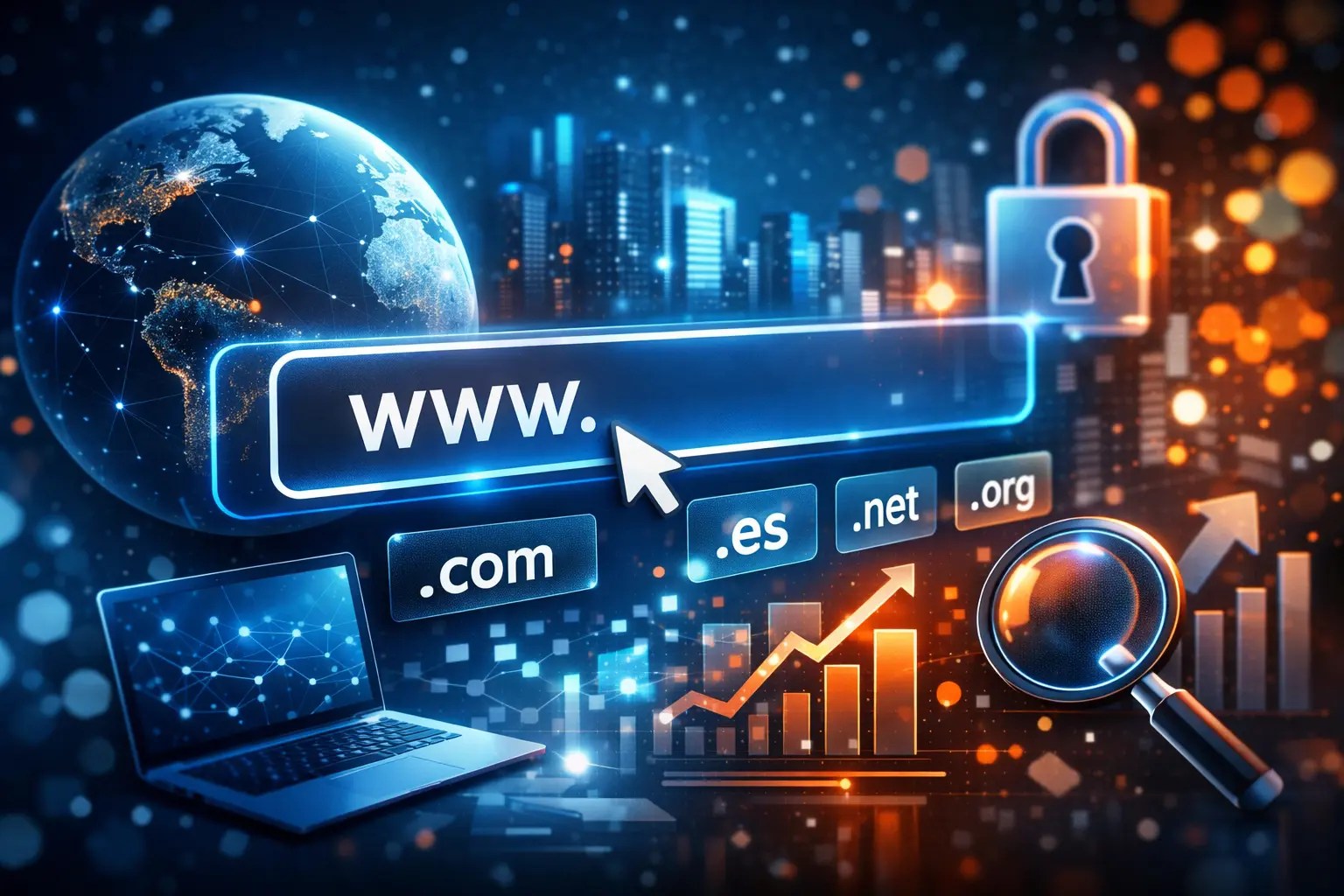 In an increasingly competitive digital environment conditioned by artificial intelligence, the web domain has ceased to be a simple technical requirement and has become a strategic piece within digital marketing. Choosing a good domain not only influences how your users find you, but also how they perceive you, how they interact with your brand and how you position yourself in search engines.
A web domain is, in essence, the gateway to your online business. It is the name that users type in the browser to access your page, replacing a complex and unmemorable IP address. But its relevance goes far beyond the technical: it is identity, branding and trust. To delve deeper into this concept from a technical perspective, you can consult this resource. Wikipedia on domain names.
Table of Contents
The domain as the basis of your digital brand
Today, the domain is one of the first elements that build the identity of a brand on the Internet. It is what users remember, what they share and what they associate with your products or services. In 2026, this brand dimension has gained even more weight as search engines prioritize recognizable and trustworthy entities over old keyword-based strategies.
For years, it was thought that including keywords in the domain was the key to better positioning. However, this practice has lost relevance. Currently, search engines interpret the domain as a signal of identity and credibility rather than as a direct ranking factor.
This means that a domain must represent your business in the long term, not just respond to a spot SEO strategy. Brands that build awareness through their domain generate more direct searches, reinforcing their global visibility.
User trust starts in the domain
One of the most important factors that a domain provides is trust. When a user sees a URL in search results, they make a decision in a matter of seconds: click or continue searching. And in that decision, domain plays a key role.
Clear, professional and consistent domains generate more clicks than those that seem unreliable or overly complex. In fact, a domain perceived as trustworthy can significantly improve click-through rate (CTR), which in turn sends positive signals to search engines.
This relationship between user perception and behavior is fundamental in modern SEO. Google no longer only analyzes keywords or links, but also how users interact with the results.
Do you want to take your SEO positioning strategy to the next level?
Briefly explain your business and your needs. We will find your solution.
The domain influences SEO (although not like before)
The role of domain in positioning has evolved. It is no longer a determining factor on its own, but it remains a key piece within the global strategy.
The domain impacts aspects such as memorability, the ease of sharing a website or the generation of natural links. The easier a domain is to remember, the more likely users are to return or recommend it. This translates into direct traffic and external mentions, two signals that do influence SEO.
In this sense, dominance is also related to the work of external authority. If you want to go deeper into this aspect, you can consult this article on how to get links and mentions to your website, which explains how to enhance the relevance of your site through off-page strategies.
Domain Extensions and User Perception
Otro aspecto importante es la extensión del dominio, conocida como TLD (.com, .es, .org, etc.). Aunque los buscadores no priorizan una extensión sobre otra de forma directa, sí influyen en la percepción del usuario.
Por ejemplo, los dominios locales como “.es” generan mayor confianza en usuarios españoles, mientras que los “.com” siguen siendo percibidos como globales. Elegir una extensión adecuada puede mejorar la identificación del público objetivo y reforzar la credibilidad de la web.
En un contexto donde el SEO local gana relevancia, especialmente con la personalización de resultados y la inteligencia artificial, este tipo de decisiones cobra aún más importancia.
Dominance in the era of artificial intelligence
SEO is changing. Searches are no longer limited to Google: assistants like ChatGPT, Gemini or Copilot are transforming the way users access information.
In this new scenario, the domain is still essential because it acts as an identifier of the source. Artificial intelligence tools prioritize content from reliable, authoritative and well-structured sites. And that authority begins, in large part, with a solid domain.
Furthermore, the concept of visibility is no longer based solely on clicks, but also on mentions. Brands with recognizable domains are more likely to appear as a reference in AI-generated responses, opening up a new dimension of digital positioning.
A key element for long-term strategy
Choosing a domain is not a minor or temporary decision. It is a strategic investment that must be thought about in the long term. Changing domains can mean loss of traffic, authority and positioning if not managed correctly.
Therefore, it is important to opt for a name that can grow with your business, that does not limit future product lines or geographic expansion. A domain that is too specific can become obsolete over time, while a well-planned one can accompany the evolution of the brand for years.
Domain, branding and user experience
The domain is also part of the user experience. A name that is easy to write, pronounce and remember improves accessibility and reduces errors. In addition, it facilitates dissemination on offline channels such as advertising, events or word-of-mouth recommendations.
In this sense, the domain connects the online and offline worlds. It is a communication element that transcends the web and is integrated into the entire marketing strategy.