

Your website is no longer enough (even though it may seem like it)
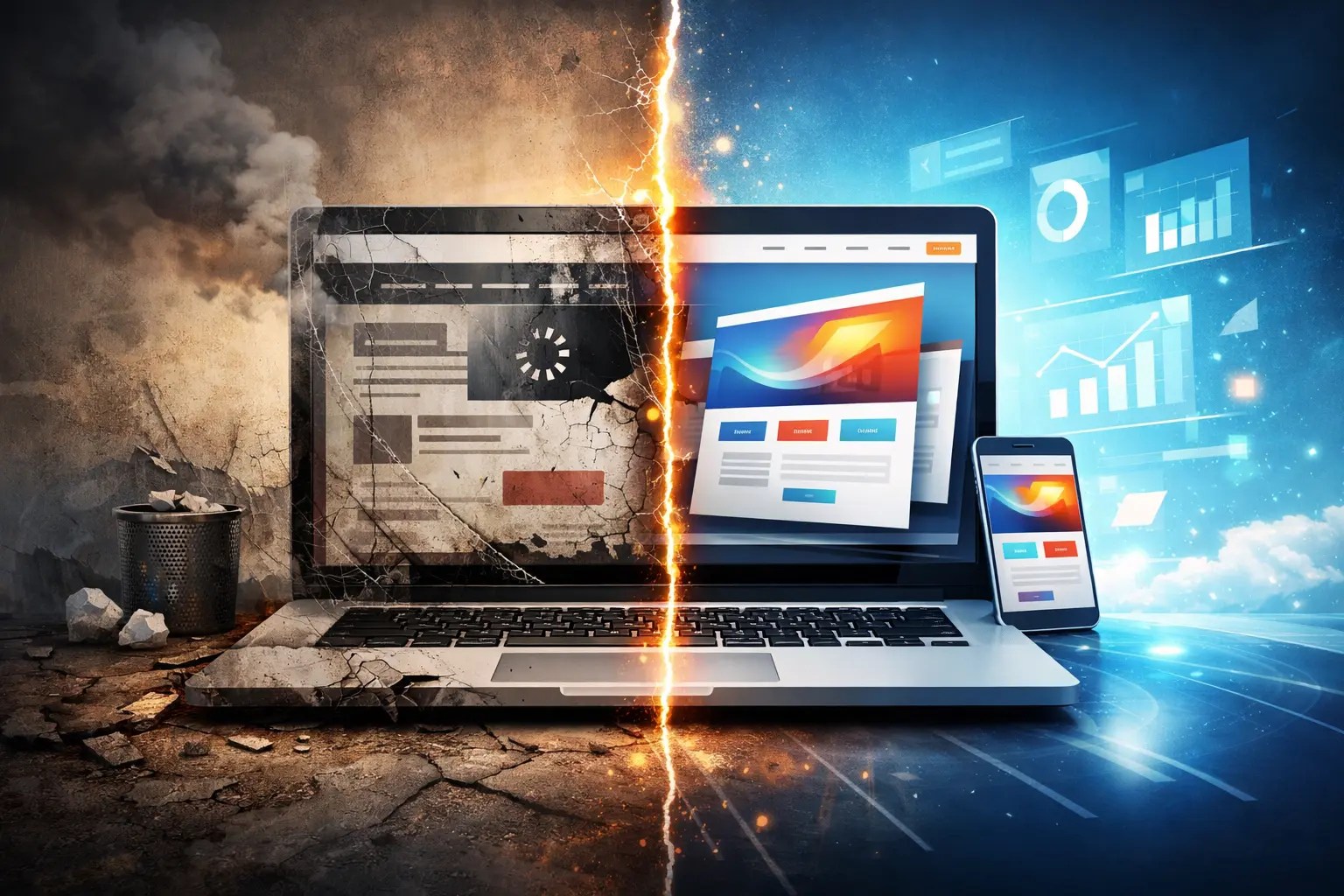 There was a time when having a Web page It was enough. It was enough to “be on the Internet” to appear modern, competitive and accessible. But in 2026 that idea has become completely obsolete. Today, an outdated website not only doesn't help: it hurts. And a lot.
The reality is uncomfortable, but necessary: your website may be driving away customers without you realizing it.
Table of Contents
An old website is not nostalgia, it is loss of business
Many companies maintain websites that were designed years ago with a logic that no longer exists. Rigid designs, confusing navigation, endless texts… all of that is part of another digital age.
The problem is not just aesthetic. It's strategic.
In 2026, the user makes decisions in seconds. If your website does not load quickly, does not adapt to mobile devices or does not convey immediate trust, it is gone. And it doesn't come back. Speed, user experience and mobile adaptation are key factors both to position and convert visits into customers.
Furthermore, Google has also evolved. It no longer simply positions “the oldest website” or the one with the most content. Reward real usefulness, experience and performance.
Your website competes, even if you don't want to. And if it doesn't evolve, it loses.
Web design in 2026 is no longer about aesthetics
For years, web design was confused with “doing something beautiful.” Today that is staying on the surface.
Today's web design is pure strategy. It influences how your brand is perceived, how the user navigates and, above all, whether they convert or not.
Current trends point to something very clear: less noise and more intention. Clean interfaces, clear visual hierarchy, leading fonts and modular structures that facilitate quick reading.
But the most important thing is not seen:
The modern web is designed to guide the user.
It's not about teaching everything. It's about teaching just enough to provoke action.
Do you want an optimized and functional web design?
Briefly explain your business and your needs. We will find your solution.
User experience rules (and always wins)
If there is a concept that defines current web design, it is user experience (UX).
Everything revolves around this: that the visitor understands, navigates and acts effortlessly.
In 2026, an effective website must be fast, intuitive, accessible and clear.
Accessibility, for example, has gone from being optional to mandatory in many contexts, incorporating adapted navigation, clear reading and understandable structures for all users.
Furthermore, design can no longer be separated from development or SEO. Everything is connected. A slow or poorly structured website is not only annoying: it disappears from the results.
Renewing is not redoing: it is rethinking
One of the most common mistakes is to think that renewing a website is “changing the design.”
It is not.
Renewing a website involves reviewing from the ground up what you offer, who you are targeting and what you want to achieve.
Because many times the problem is not in how the website looks, but in what it says (or what it doesn't say).
The web redesign in 2026 is part of the strategy. Next comes the structure. And only at the end, the visual design.
This approach is what makes the difference between a website that is “okay” and one that really works.
Artificial intelligence is already changing the rules
If a few years ago talking about artificial intelligence seemed futuristic, today it is a reality integrated into web design.
From content generation to experience personalization, AI is redefining how web pages are created and evolve.
More and more companies are exploring new ways to build their sites with automated tools. If you are interested in this approach, you can delve into how to make a website with artificial intelligence.
But be careful: AI is not a substitute for strategy. The power.
An automatically generated website without a clear focus will still be a bad website.
Your website is your best commercial (or the worst)
Think of your website as a salesperson that works 24 hours a day.
Now imagine that this salesperson speaks slowly, does not respond well, does not understand the customer and also gives a bad image.
That's exactly what happens with an outdated website.
On the contrary, a well-designed website conveys confidence, guides the user and facilitates conversion. It is fast, clear and useful.
And that translates directly into business.
The real cost of not renewing
Many companies delay the renewal of their website due to cost reasons.
But the real cost is not updating it.
It's not doing it.
Every visit that doesn't convert, every user that abandons, every lost opportunity... all of that has a real impact on the bottom line.
Furthermore, in an environment where digital competition is constantly growing, falling behind is not a neutral option. It's going back.
Renew to grow, not just to update
Renewing a website should not be a pending task that is done every ten years.
It should be a constant evolution.
The digital environment changes rapidly, but it also offers enormous opportunities for those who know how to adapt.
Today, a website is not just a cover letter. It is a recruitment, sales and positioning tool.
And like any key tool, it needs to be up to date.
If you want to continue delving deeper into digital strategies, you can also consult specialized resources such as the guide to Google on user experience and Core Web Vitals, a good starting point to understand where the Internet is evolving.