
For years, searching for products on the Internet involved browsing through dozens of online stores.
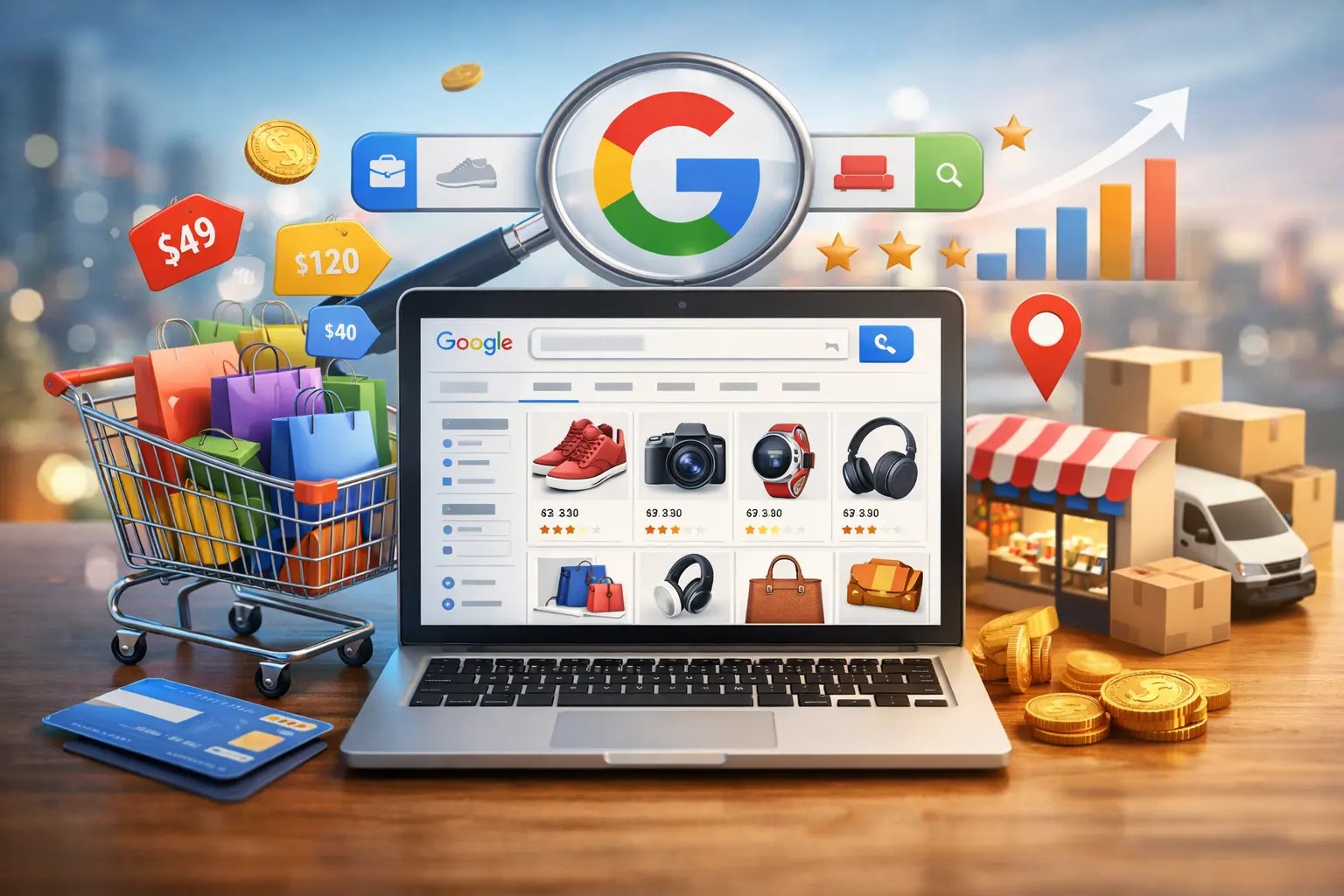 Durante años, buscar productos en Internet implicaba navegar entre decenas de tiendas online, comparar precios manualmente y tomar decisiones con información fragmentada. Today, this process has been radically simplified thanks to Google Shopping, a tool that has evolved from a simple price comparator to become a true digital showcase where brands and consumers meet at the key moment: just before the purchase.
Google Shopping is not an online store in itself, but rather an environment where users can discover products, compare options and directly access the businesses that sell them. Its main value lies in the immediacy and visual format: images, prices, ratings and availability appear before the user even clicks. This completely changes the logic of digital marketing.
Table of Contents
The new behavior of the digital consumer
The user of 2026 no longer navigates, he decides. The evolution of e-commerce and the integration of artificial intelligence have made purchasing decisions faster, more informed and, above all, more visual. Google Shopping responds perfectly to this new pattern: it eliminates friction and presents products directly in search results.
When someone searches for “men's running shoes” or “chaise longue sofa,” they don't want to read long texts. You want to see options, compare prices and choose. Google Shopping acts as that immediate showcase that connects search intent with conversion. It is no coincidence that these types of ads appear in privileged positions within the search engine, capturing attention before traditional organic results.
What Google Shopping really is in 2026
In essence, Google Shopping is still a product comparison system that shows items from different online stores, but its operation has become more sophisticated. Today it combines structured data, automation and machine learning to deliver highly relevant results.
Companies upload their product catalog through Google Merchant Center, where they include information such as price, description or availability. This information is connected to Google Ads, which allows those products to be promoted through pay-per-click campaigns.
But the interesting thing is that not everything depends on the bid anymore. Google uses behavioral, context, and feed quality signals to decide which products to show. In other words, the person who pays the most no longer necessarily wins, but rather the person who works their strategy best.
Do you want to get the most out of your Google Ads strategy?
Briefly explain your business and your needs. We will find your solution.
From showcase to strategic sales channel
A decade ago, Google Shopping was seen as a complement to search campaigns. Today it is, in many sectors, the main channel for attracting sales.
This is because it impacts the user very late in the funnel. Those who search for a specific product and see results with price, image and store are much closer to purchasing than those who perform a generic search. Google Shopping does not generate demand, it captures it.
In addition, its visual format significantly improves CTR and traffic quality. The user who clicks has already seen the product, the price and the brand, so they arrive with a much clearer intention.
The importance of the product feed
If there's one critical element to any Google Shopping strategy, it's the product feed. It's not just about uploading a catalog, but about optimizing each attribute so that Google perfectly understands what you are selling.
The title of the product, for example, has become a key piece. It should include relevant keywords, but also be natural and descriptive. The image, for its part, must be clear, attractive and comply with Google policies.
Price and availability must always be up to date, as any inconsistency can affect campaign performance or even lead to product deactivation.
Working well with the feed is not just a technical task; It is a strategic work that connects directly with the performance of the campaigns.
Automation, AI and the future of Shopping
In 2026, talking about Google Shopping is also talking about automation. Smart campaigns and models based on artificial intelligence have changed the way advertising is managed.
Google no longer just shows products; recommends them. It analyzes user behavior, previous searches, location and other factors to personalize the shopping experience.
This poses a new challenge for brands: it is not enough to be present, you have to be relevant in an increasingly competitive and automated environment. Optimization is no longer just focused on keywords or bids, but on data, structure and overall strategy.
How to integrate Google Shopping into your SEM strategy
Google Shopping does not work in isolation. It must be integrated into a SEM strategy broader that includes search, remarketing and branding campaigns.
For example, a user may discover a product in Shopping, investigate later through a search, and finally convert after seeing a remarketing ad. Everything is part of the same ecosystem.
If you're just starting out, understanding how Google Ads campaigns work is essential. In this sense, we recommend this resource to take the first steps: create your first campaign in Google Ads
This type of basic training is key to understanding how the different pieces connect.
Common mistakes that are still valid
Despite the evolution of the tool, many errors continue to be repeated. One of the most common is to treat Google Shopping as if it were a traditional search campaign. There are no keywords here as such; The focus is on the feed.
Another common mistake is neglecting profitability. It's not just about generating clicks, but about selling profitably. This involves analyzing margins, adjusting bids and correctly segmenting products.
It is also common not to take advantage of the full potential of data. Google Shopping offers very valuable information about the performance of each product, and not using it is losing a clear competitive advantage.
An essential channel for ecommerce
Google Shopping has established itself as one of the pillars of digital marketing for ecommerce. Its ability to connect purchase intent with immediate visibility makes it an essential tool.
It is no longer an option, it is a necessity for any online store that wants to compete in an increasingly demanding environment. The key is not only to use it, but to do it with a clear, data-based and results-oriented strategy.
If you want to delve deeper into advanced online advertising strategies, you can also consult this external reference resource on Google Shopping:
https://www.idento.es/blog/sem/como-funciona-google-shopping/
In short, going “shopping with Google Shopping” in 2026 is not just a user experience, but a strategic opportunity for brands that know how to take advantage of it.